The Contemporary Cave
Almost every morning, I repeat a small ritual. I go for a walk with my wife and our dog before the day begins to demand attention. Before the chores, the calls, the construction sites, the meetings, and that constant noise that accompanies contemporary life, there is a brief space of silence where the body barely wakes up and the mind begins to observe. Walking has become, without my realizing it, a way of thinking. There are days when conversation flows naturally. Others when we simply share the path in silence. But almost always, something appears that triggers a reflection. A shadow projected on a wall. A facade weathered by time. The way someone appropriates a sidewalk. An open window. A tree that seems to have decided to reclaim the territory that once belonged to it. Or simply the strange tranquility produced by a specific corner of the city. Recently, during one of those walks, I ended up thinking about something that seemed very simple, but which began to grow in my head until it became a much deeper question. The primitive relationship between human beings and space.
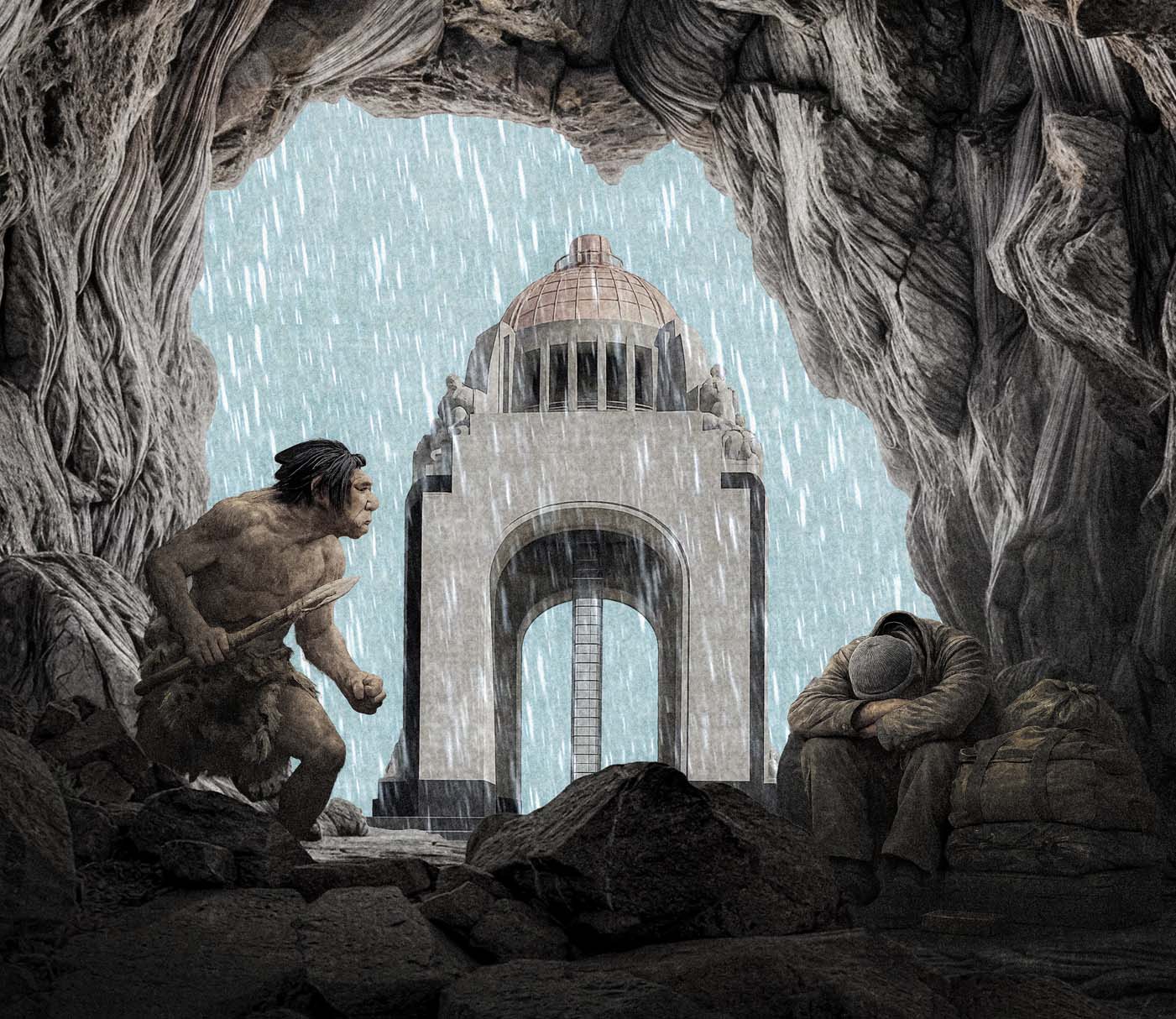
I remember passing in front of the Monument to the Revolution, which is located just a few streets from where we live. There is something extraordinarily powerful about that building. Not only because of its monumental scale or the forcefulness of its architectural composition. But also because of everything it represents. Thinking that it was originally going to become the Federal Legislative Palace during the Porfiriato and that, after the Mexican Revolution, it ended up being transformed into a monument loaded with historical memory, made me reflect on a fascinating idea: architecture can also change its meaning without changing its form.
The structure remained. The narrative transformed. And that paradox seems deeply revealing to me. As I observed that enormous mass of metal structure clad in quarry stone, resting on volcanic rock and crowned by a copper dome, I thought that buildings do not only construct spaces. They also store aspirations, conflicts, ideologies, and memories. They outlive those who built them and end up becoming something like capsules of collective memory. However, the reflection that gave rise to this text was not born from observing the dome. It was born a few meters below. In one of the sunken plazas of the Monument to the Revolution, there are several niches and residual spaces generated by the composition of the complex itself. Places that were probably conceived as transitions, voids, or simple secondary pieces within a much larger architectural operation. But that morning I observed something else. Some people experiencing homelessness had begun to inhabit them. There were blankets. Cardboard. Personal belongings. Carefully arranged objects. And suddenly, those spaces ceased to be geometries. They became shelters. Temporary homes. A sort of contemporary cave.
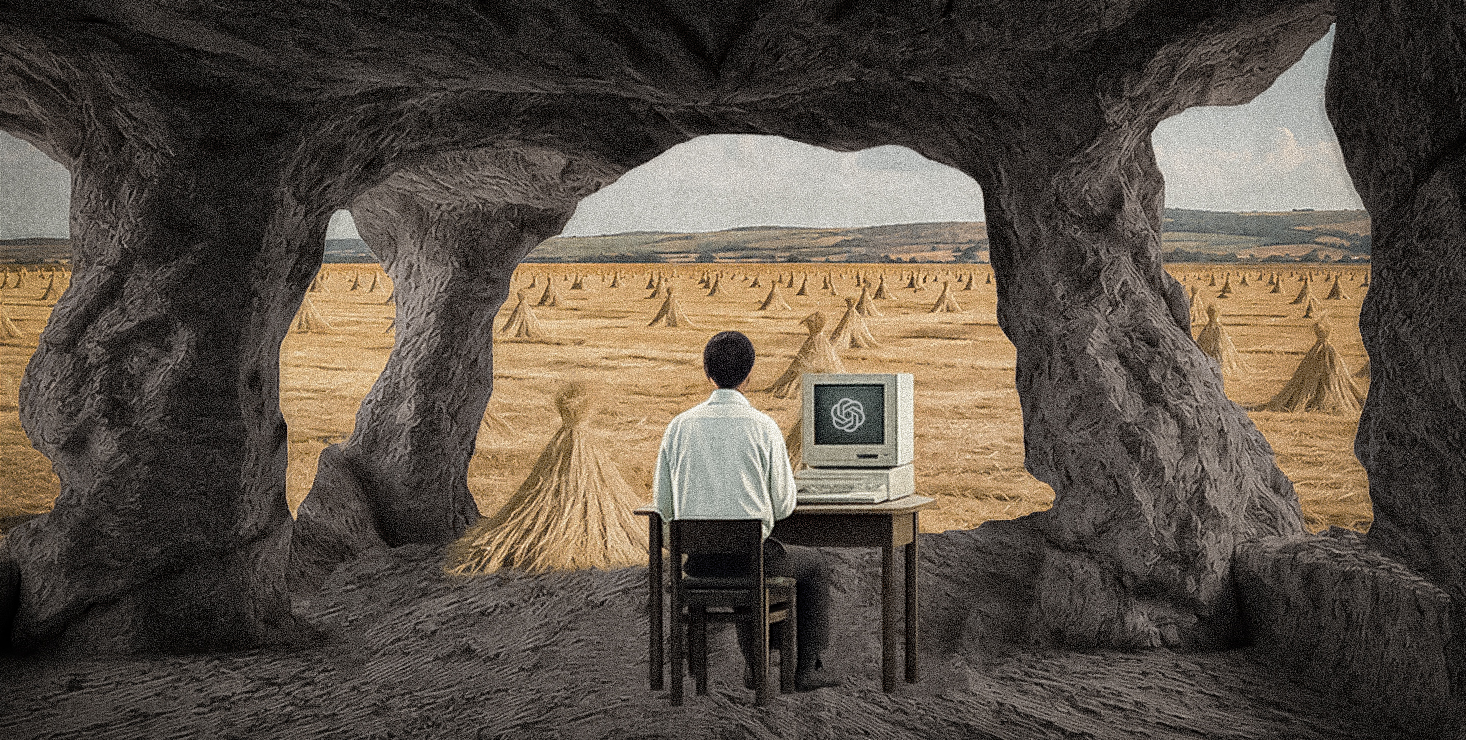
It was exactly at that moment when this reflection was born. Because, regardless of any economic, political, or social context, human beings continue to do something they have done since the beginning of their history. Appropriating space to survive. That gesture felt deeply human to me. Those people were not thinking about architectural theory or the history of the monument. They were responding to a much more elemental need. To protect themselves. To seek shelter. To create a boundary between a hostile exterior and a small interior of their own. And that was when an idea appeared that seemed fundamental to me. The appropriation of space will always exist. Architecture, on the other hand, will not. The difference may seem subtle, but it completely changes the way we understand our relationship with our surroundings. Human beings can temporarily occupy any place. They can use a shadow. They can take shelter under a rock. They can sleep under a bridge. They can pass through a space and momentarily make it their own. Appropriation is immediate. Instinctive. Architecture appears later. Much later. Before monuments, before cities, and even before architecture, humanity was already dwelling. A rock that offered shade. A tree capable of protecting from the rain. An accidental cavity. All those places represented something deeply human: the search for shelter. The cave was probably the first space consciously appropriated by our species. And although we usually imagine it as a symbol of precariousness, I suspect it was one of the most revolutionary spaces in human history. Because the cave was not solely a physical shelter. It was a boundary. It was protection. It was identity. Within it appeared shared fire, rest, the first human gatherings, and the first rituals. Cave paintings also appeared. And those paintings are far more important than they seem. They were not decoration. They were evidence of consciousness. Humanity was not just surviving. It was beginning to leave a mark. It was beginning to construct meaning. But I believe that architecture, as we understand it today, was born much later. It was born when we stopped moving constantly. When agriculture appeared. When, for the first time, human beings found reasons to remain in one place. Cultivating implied waiting. And waiting implied rootedness. That transformation altered our relationship with space forever. The first settlements appeared. The first notions of territory. The first ideas of property. The first boundaries between the collective and the private. Between the inside and the outside. Between that which belongs to everyone and that which guards the intimacy of a family or a community. And along with those distinctions, something even more important was born. Civilization. Because cities do not arise solely from the need to build. They arise from the need to remain together. The appropriation of space is as old as humanity. Architecture, on the other hand, is born when the will to remain appears.
That is why I find it difficult to think of architecture separate from territory. If architecture is born from rootedness, then it necessarily belongs to a place. It cannot exist in isolation. It has to respond to the climate. To solar orientation. To the available materials. To the construction techniques developed over generations. To the landscape. To the culture. To collective memory. And above all, to the people who inhabit it. Perhaps that is why vernacular architecture remains one of the greatest lessons for our profession. Because it represents centuries of accumulated knowledge on how to properly inhabit a territory. True sustainable architecture is not just the kind that consumes fewer resources. It is the kind that belongs to the site. The kind that seems to emerge from it. The kind that feels inevitable. As if it had grown naturally from the ground. Perhaps that is why architecture has always been deeply linked to time. Building is a declaration of permanence. It is a way of saying we will be here. That is why I was so struck by that scene under the Monument to the Revolution. Because it reminded me that, despite the thousands of years that have passed, we are essentially the same species. We live surrounded by concrete, glass, algorithms, and hyperconnected cities. But we are still searching for the same thing our ancestors searched for. We are still building caves.
The contemporary home. The apartment. The studio. The office. Even certain public spaces. They all respond, at their core, to a deeply ancestral need. To feel protected. And to feel that we belong to something. Materials change. Technologies change. Scales change. The human condition remains. But there is another dimension to architecture. A dimension that goes beyond shelter and beyond the correct response to territory. It is the ability to move us. Because there are spaces where the body lets its guard down before the mind understands why. Silent courtyards. Libraries. Temples. Gardens. Rooms illuminated by the right light. Corners where we feel shelter without needing to explain it. I suspect this happens because certain architectures connect with something very ancient that remains alive within us. With the need to remain. With the need to belong. With the need to find meaning. And perhaps therein lies the highest form of architecture. Not when it resolves a program. Not when it wins an award. Not when it is published in a magazine. But when it manages to become part of people's lives. The spaces we love are the spaces we care for. And the spaces we care for are the spaces that remain. Perhaps true sustainability does not begin with technology. Perhaps it begins when a work is capable of generating enough meaning for a community to decide to preserve it. We live in an era marked by constant movement. Everything seems designed to accelerate. Cities. Networks. Work dynamics. Even our attention. Remaining has become increasingly difficult. And yet, we keep searching for it. We keep trying to build places where we can recognize ourselves. Spaces where time slows down. Where we can feel that we belong, if only for an instant. And that is where architecture finds its deepest meaning. Because behind every building, every house, and every space we inhabit, there still exists an ancestral need that has accompanied us since the beginning of our history. The need to find a place in the world. And perhaps that is why I keep thinking about that morning walk. Because I ended up wondering if, after thousands of years of evolution, we are still looking for the exact same thing the first human being sought upon entering a cave. A space to feel protected. A space in which to remain. A space we can call home.